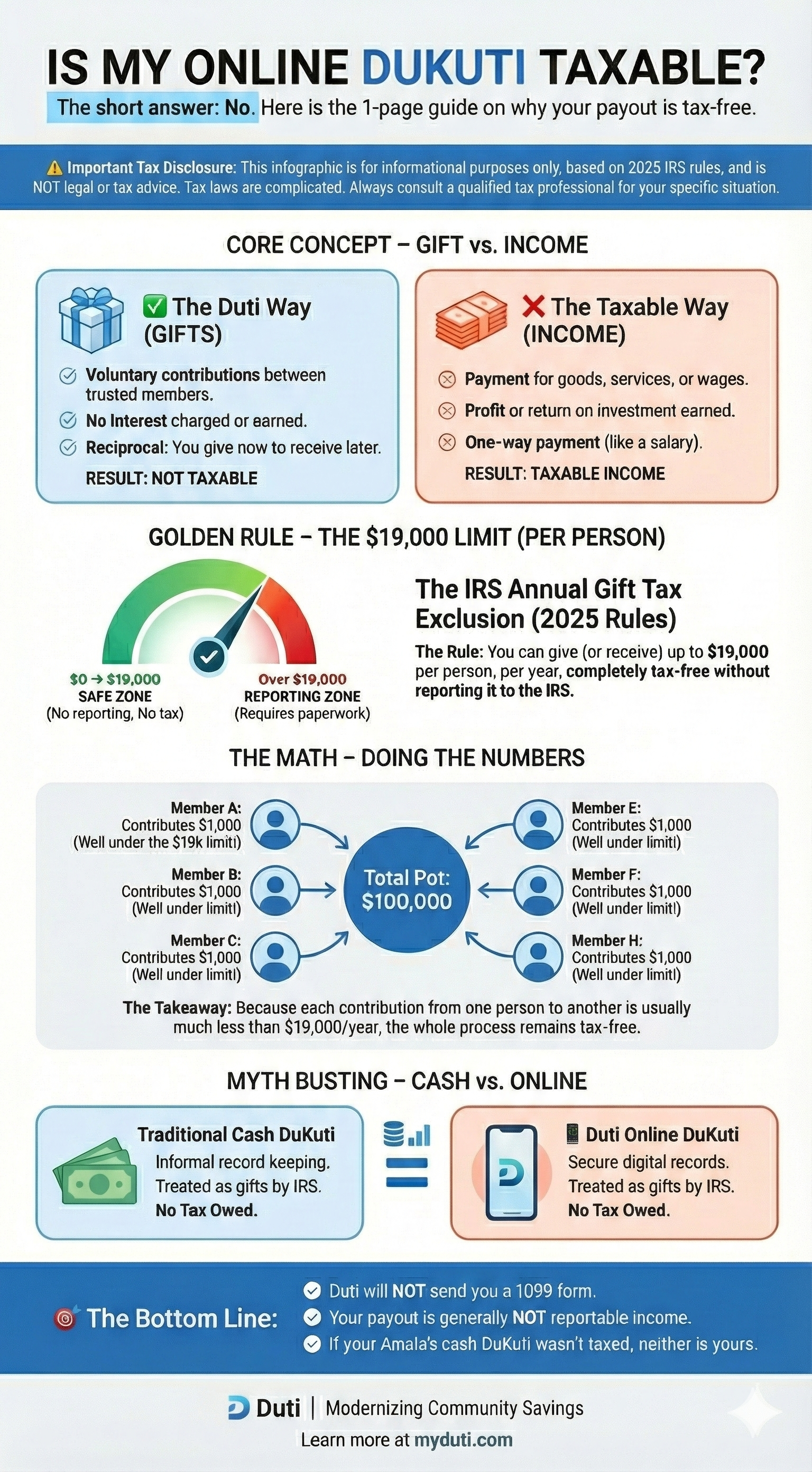
Do You Owe Taxes on Your DuKuti Payout?
⚠️ Tax Disclosure: This article is for informational purposes only and should not be considered tax, legal, or financial advice. Tax laws are complex and subject to change. Always consult with a qualified tax professional for your specific situation.
The Question Everyone Asks
"If my DuKuti is online, won't the IRS see it? Do I have to pay taxes?"
This is the #1 concern we hear from our community. The short answer: for a typical DuKuti, generally no — your payout is not treated as taxable income.
Let's explain exactly why, and cover the one situation where the answer can be different.
🎁 The Quick Answer
How the IRS Gift Rule Protects You
The IRS has a clear rule called the Annual Gift Tax Exclusion. As of 2026, you can give (or receive) up to $19,000 per person, per year without any tax consequences.
Why DuKuti Contributions Are Generally Treated as Gifts
In a DuKuti (ROSCA), each member's contribution works like a gift to the recipient of that round's pot. Here's why this matters:
✅ What Makes It Gift-Like
- • Voluntary — members choose to contribute and can leave the circle at any time
- • No interest charged or earned on contributions
- • Not payment for goods, services, or work
- • Given freely within a trusted community circle
❌ What Would Make It Income
- • Interest payments (like a loan)
- • Profit or return on investment
- • Payment for goods or services
- • Wages or compensation
There's also a second layer of protection that's easy to overlook: over a full cycle, you receive back what you contributed. If you put in $1,000 a month for 100 months and receive a $100,000 payout, you haven't gained anything — and the IRS taxes gains, not your own money coming back to you.
Real Example: Tenzin's 100-Person DuKuti
Let's look at how the math works with a real-world scenario:
📊 Tenzin's DuKuti Circle
| Members | 100 people |
| Monthly contribution | $1,000 per person |
| Monthly pot | $100,000 |
| Largest single gift | $1,000 (from each member) |
| IRS gift limit | $19,000 |
| Tax owed | $0 |
Cash DuKuti vs. Duti Online: Same Tax Treatment
The only thing that changed is the convenience—not the tax treatment. The same IRS rules that applied to your ama-la's cash DuKuti apply to your online DuKuti with Duti.
| Cash DuKuti (Traditional) | Duti Online DuKuti | |
|---|---|---|
| Taxes owed | None | None |
| 1099 form issued | No | No |
| IRS reporting required | No | No |
| Legal structure | Gifts between members | Gifts between members |
| Record keeping | Paper/informal | Digital (automatic) |
| Security | Risk of loss/theft | Bank-level security |
The One Exception to Know: Bidding Circles
Everything above describes a typical DuKuti, where over a full cycle you receive back what you contributed. Bidding circles work a little differently, and it's worth understanding.
In a bidding DuKuti, members bid for early access to the pot. Members who take an early payout accept a discount, and members who wait can end up receiving more than they contributed over the cycle.
⚠️ If You Receive More Than You Put In
Frequently Asked Questions
Do I have to pay taxes on my DuKuti payout?
For a typical DuKuti, generally no. Your payout is the combined contributions of other members — each one well under the $19,000 annual gift exclusion — and over a full cycle you receive back what you put in. The exception: if you receive more than you contributed (for example, through winning bids), that extra portion may be taxable. See the bidding section above.
Will Duti send me a 1099 tax form?
Duti does not currently issue 1099 forms for DuKuti participation. 1099s report income, interest, or payments for services — a typical DuKuti payout is none of these. Reporting rules can change over time; if they ever do, we'll update this guide and notify members.
What if the IRS asks about my DuKuti?
This is extremely unlikely for typical DuKuti amounts. But if it ever happened, your Duti transaction history shows exactly what occurred: every contribution you made, your payout, and — most importantly — that over the cycle you received back what you put in. Complete records are your best protection in any tax question.
Is online DuKuti different from cash DuKuti for taxes?
No. The method of transfer (cash, check, bank transfer, or Duti) doesn't change the tax treatment. What matters is the nature of the transaction—and both are gifts between members of a savings circle.
What records should I keep?
Duti automatically maintains your complete transaction history in your dashboard. This includes every contribution you made and your payout date/amount. You can download this anytime for your personal records.
What if my DuKuti circle is larger than usual?
Circle size doesn't matter—what matters is how much one person gives to another person in a year. Gift-tax questions generally only arise if you personally contribute more than $19,000 to the same person within a single year. For example, if your monthly contribution is $2,000 and the same person wins 10+ times in a year from you—that's extremely unlikely. In virtually all DuKuti scenarios, you're well under the limit.
What Duti Does (and Doesn't) Report
✅ What Duti Does
- • Keep secure transaction records
- • Provide you with transaction history
- • Process payments securely
- • Protect your personal information
❌ What Duti Does NOT Do
- • Issue 1099 forms
- • Report payouts as income to the IRS
- • Withhold taxes from your payout
- • Classify DuKuti as taxable income
The Bottom Line
🎯 Key Takeaways
- ✨ Typical DuKuti payouts work like gifts, not income—generally no taxes owed
- ✨ $19,000 annual gift limit covers typical DuKuti amounts easily
- ✨ Over a full cycle you get back what you put in—no gain, nothing to tax
- ✨ Online = Cash for tax purposes—same rules apply
- ✨ One exception: amounts you receive beyond your contributions (like bid winnings) may be taxable—ask a tax professional
Share This Information
Have family or friends who are worried about taxes? Share this article with them, or download our one-page summary:
Also available in Tibetan: དུ་ཏི་དུ་ཀུ་ཏི་ལ་ཁྲལ་མེད་པའི་རྒྱུ་མཚན།
Important Disclaimers
This is Not Tax Advice: Tax laws are complex and individual circumstances vary. This article provides general information about how DuKuti typically works under current IRS gift rules, based on our good-faith reading of those rules — the IRS has not specifically ruled on savings circles. Always consult with a qualified tax professional (CPA or tax attorney) for advice specific to your situation.
State Laws May Differ: Some states have their own gift tax rules. Check your state's requirements if applicable.
Large Amounts: If your DuKuti involves unusually large amounts (approaching $19,000 from a single person), consult a tax professional.
Bidding Gains: If you receive more over a cycle than you contributed — for example, through winning bids — that portion may be taxable income. Consult a tax professional about how to report it.
Documentation: While gifts under $19,000 don't require IRS reporting, maintaining records protects all parties. Duti provides transaction history for your reference.
Learn More: For current IRS regulations, visit www.irs.gov or consult with a tax professional.
Related Articles: